
Resources > Blog > Encouraging Employees to Speak Up is Important. How Leaders Respond is Critical.
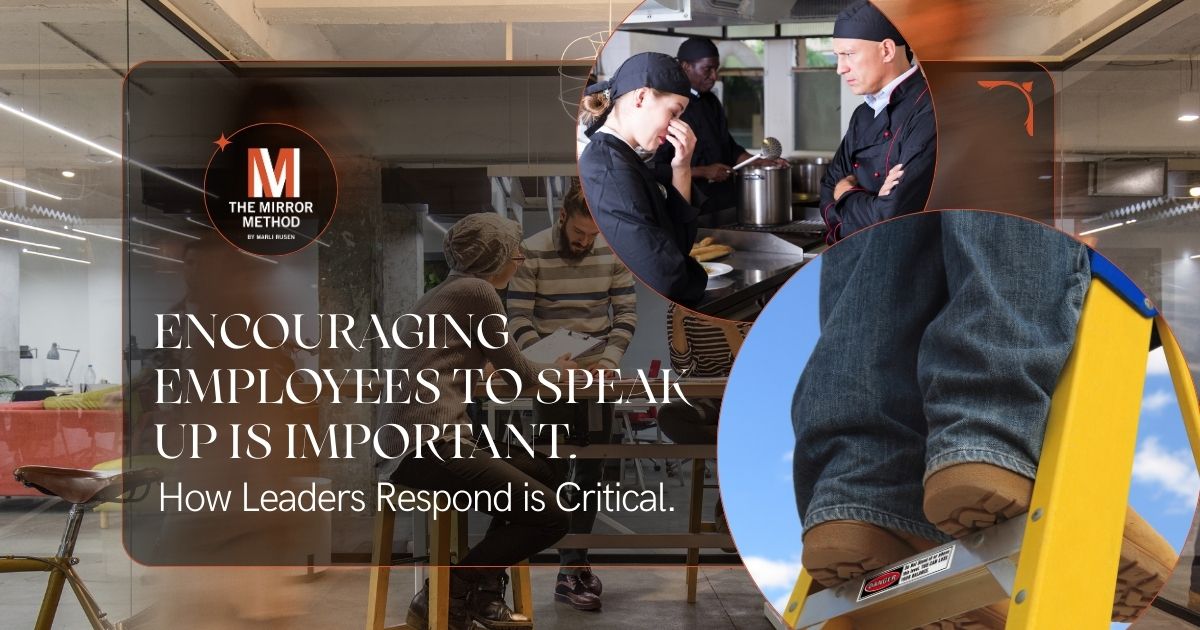
I recently saw commercials produced by WorkSafeBC encouraging staff to speak up when they felt unsafe. There were different “versions” of the same campaign. In one, an employee saw their coworker on a high ladder with no safety precautions. In another, an employee was confused about quick instructions from their supervisor about dangerous cleaning products.
In each, the employee is thinking to themselves “This doesn’t feel right, there has to be a better way”. And in each, the commercial ends with “Questions? Talk to your boss”.
What this Campaign Fails to Consider
While I appreciate the importance of workplace safety and give credit to WorkSafe for its efforts, I worry about the over-simplification of this “call-to-action”. In my experience, far too many employees have spoken up about safety concerns and have faced real life and very negative consequences for doing so. This has ranged from radio silence to outright retaliation for questioning existing procedures. Those who “speak up” in certain environments are labelled as negative, hypervigilant, difficult, or simply “not a good fit” [read: “too much work”].
Retaliation – especially in the context of safety – does not often show up as a direct reprimand. Instead, it arises in more subtle and intangible ways including: being excluded from conversations; losing shifts, promotions and other opportunities; being met with irritation and impatience; or suddenly having their performance scrutinized and questioned. These responses send a clear message to both the affected staff member and anyone watching – that a stress-free future in the organization requires their silence and complicity.
For many workers, not asking feels safer than working unsafely. That says a lot. They recognize the hazard, and accept the risk knowing the stakes associated with doing otherwise. This gap – between the scenario in the commercials and the reality faced by many workers – is where true safety hurdles live.
A Campaign for Supervisors
A respectful safety culture demonstrates to employees that they have a right to ask questions – and obtain answers – without fearing retaliation. This requires confidence in those on the receiving end of the questions being asked. If organizations do not better manage the way safety issues are addressed by certain leaders, employees will fear coming forward, even when they know something is not right.
Instead of (or even “in addition to”) encouraging employees to speak up, it is critical for WorkSafeBC to mandate training for employers and leaders on how to meaningfully and respectfully respond to safety concerns. Front-line supervisors and all members of OHS committees need to be properly trained in how to objectively and respectfully review and resolve safety issues that come forward.
Workplace leaders play a critical role in defining the day-to-day safety culture of any organization. They need clear mandates on how to respond when issues arise.
Commercials won’t move the dial on workers’ willingness to raise concerns. This will come down to how well leaders listen – and how effectively they respond – in the face of real-life scenarios.
A Safe Culture is Everyone’s Responsibility
Employees cannot carry the responsibility for workplace safety on their own. If we expect them to speak up when something feels unsafe, we must expect leaders to properly and fairly respond. Safety is a shared responsibility that depends on clear roles and responsibilities, responsive leadership, and accountability for all.
For organizations looking to strengthen their safety culture, through mutual respect and fair process, please reach out anytime. This is what The MIRROR Method is all about: